
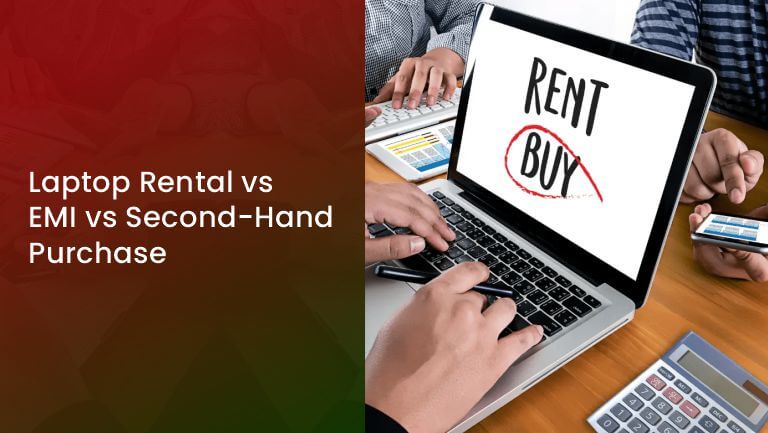
Laptops have never been cheap — and in 2024, they are getting pricier. A mid-range business laptop in India can set a buyer back anywhere between ₹50,000 and ₹1,20,000. For a startup bootstrapping its operations or a freelancer managing tight monthly budgets, that number alone can trigger serious decision fatigue.
Three paths are commonly considered: buy on EMI, pick up a second-hand unit, or go for a Laptop Rental. Each option has its advocates, its advantages, and — importantly — its hidden pitfalls. Choosing the wrong one does not just affect the wallet. It can disrupt workflows, create maintenance headaches, and lock a business into inflexible commitments at the worst possible time.
This is exactly where platforms like Indianrenters step in. As a trusted laptop rental company operating across India, Indianrenters helps businesses, startups, freelancers, and project teams access the latest laptops without high upfront costs, long-term lock-ins, or maintenance worries.
This article offers a clear, honest comparison across all three options — cost, risk, flexibility, and fit — so readers can make a decision they will not regret.
What Is Better: Laptop Rental, EMI, or Second-Hand Purchase?
The short answer: it depends on the use case, budget, and duration of need. But when most variables are weighed honestly, Laptop Rental consistently emerges as the most practical and cost-efficient solution for businesses and professionals who need flexibility and reliability without the burden of ownership.
EMI purchases make sense for individuals who are certain about long-term personal use and want eventual ownership. Second-hand purchases may appeal to those with very limited one-time budgets and low performance requirements. However, for business use, project-based work, or when scalability matters, a well-structured rental plan delivers significantly more value.
How Does Laptop Rental Compare to EMI in Long-Term Cost?
Many assume that buying on EMI is always cheaper over time because ownership eventually transfers. The math, however, tells a more nuanced story.
Cost Breakdown: EMI vs Rental
Consider a business-grade laptop priced at ₹80,000. On a 24-month zero-interest EMI plan, the monthly outflow is roughly ₹3,333. Now factor in what EMI calculations often leave out:
- Accidental damage or repair costs: Even under warranty, physical damage rarely qualifies for free repairs. A single screen replacement can cost ₹10,000–₹20,000.
- Software and antivirus subscriptions: Annual costs of ₹3,000–₹8,000 are almost always the buyer’s responsibility.
- Technology obsolescence: A laptop bought today on a 24-month EMI will be two-year-old hardware the moment it is paid off — with no straightforward upgrade path.
- Resale losses: Laptops depreciate aggressively. A ₹80,000 laptop might fetch ₹25,000–₹35,000 after two years if it is in good condition.
A Laptop Rental from Indianrenters, by comparison, typically runs between ₹1,500 and ₹4,500 per month, depending on the device specification and rental duration. That cost includes maintenance support, no hidden damage premiums, and the flexibility to upgrade the device as needs evolve — without purchasing a new unit.
Hidden Charges in EMI Plans
Finance charges, processing fees, and mandatory insurance premiums can add 8–15% to the effective cost of EMI purchases, especially through consumer electronics retailers. Reading the fine print of any EMI plan is critical. Many “no-cost EMI” offers are priced into the product itself, making them less attractive than they initially appear.
Are Second-Hand Laptops Really Cost-Effective?
Second-hand laptops attract buyers with one compelling argument: a lower sticker price. A refurbished or used laptop that originally retailed at ₹70,000 might be available for ₹25,000–₹35,000 on platforms like OLX or local resellers. That sounds like a bargain — until the total cost of ownership is considered.
Ownership Risks with Used Laptops
Second-hand laptops carry risks that are rarely reflected in the selling price:
- Battery degradation: Most used laptops have batteries that hold 50–70% of their original charge capacity. Replacement costs range from ₹3,000 to ₹8,000.
- No warranty: Once a laptop’s manufacturer’s warranty expires, all repair costs fall on the buyer. Logic board failures on popular business laptops can cost ₹15,000–₹40,000 to fix.
- Unknown usage history: A laptop listed as “barely used” may have been running 10 hours a day in a demanding environment. Internal wear is invisible until something breaks.
- Outdated hardware: A three-year-old processor, limited RAM, and a slower SSD will bottleneck productivity in CPU-intensive tasks like video editing, data analysis, or running virtual machines.
- Data security concerns: Used devices can carry residual data or compromised firmware, which creates a genuine security risk for business users.
For a startup handling client data or a professional working on time-sensitive projects, a second-hand laptop is rarely the cost-effective choice it first appears to be.
Who Should Choose Laptop Rental Instead of Buying?
Laptop Rental is not just a fallback option for those who cannot afford to buy — it is a strategically sound choice for a wide range of users and business scenarios.
Startups and early-stage businesses benefit most from rentals. In the first 12–18 months, cash preservation is critical. Committing capital to depreciating hardware makes little financial sense when that same money could fund product development, marketing, or hiring. Renting from a reliable laptop rental company like Indianrenters allows startups to equip entire teams for a predictable monthly cost without a large upfront outlay.
Project-based professionals and agencies frequently need high-performance laptops for 3–6 months — for a film production, a software development sprint, or a data migration project. Buying devices for temporary work only creates disposal and resale headaches at project end.
Businesses scaling teams rapidly face a recurring procurement problem: buying 10 laptops today means 10 devices to manage, repair, and eventually replace. Rental solves the scalability challenge cleanly — add devices when headcount grows, return them when it shrinks.
IT professionals and developers testing hardware configurations often need access to specific machines without committing to purchase. Short-term rentals make this cost-effective and practical.
Students and professionals between jobs who need a capable machine during a transition period are also ideal candidates for flexible short-term laptop rentals.
What Are the Risks of EMI and Used Laptops?
Both EMI purchases and second-hand acquisitions carry risks that deserve serious consideration — particularly for businesses where downtime has a direct cost.
Risks of EMI Purchases
- Long-term commitment without flexibility: Once EMI begins, the buyer is locked in regardless of how their needs change. A startup that takes 10 laptops on EMI and then downsizes by 40% is still paying for hardware it no longer needs.
- Obsolescence lock-in: Technology moves fast. A laptop purchased today may feel underpowered within 18 months, especially in fields driven by AI tools, high-resolution video, and large datasets.
- Depreciation loss: On average, laptops lose 30–40% of their market value in the first year. EMI buyers absorb this depreciation entirely.
Risks of Second-Hand Laptops
- No recourse for failures: Without warranty, a hardware failure at a critical moment can mean days of lost productivity and unexpected repair expenses.
- Compatibility issues: Older operating system versions, outdated drivers, and unsupported software create ongoing IT headaches.
- Security vulnerabilities: Older machines may no longer receive security updates from manufacturers, leaving business data exposed.
The aggregate risk profile of both options is considerably higher than most buyers account for at the point of decision.
Why Is Laptop Rental the Smart Choice for Businesses and Startups?
Laptop Rental strips away the overhead that comes with ownership while delivering the same — often better — hardware experience. For businesses and startups in particular, the advantages compound quickly.
No capital expenditure: Rental converts a high one-time cost into a predictable operational expense. This is a significant advantage for financial planning and tax treatment (rentals are typically deductible as business expenses in India).
Always-current technology: Rental agreements allow businesses to upgrade to newer models as technology evolves, ensuring teams are never stuck on outdated hardware.
Maintenance and support included: A reputable laptop rental company handles hardware issues, reducing the burden on internal IT teams and eliminating unplanned repair costs.
Scalable and reversible: Businesses can increase or decrease the number of rented devices as team size changes — something that is simply not possible with purchased hardware.
Lower risk, faster deployment: Rental devices are typically pre-configured and ready to deploy, which means new team members are productive faster.
For a startup running lean or an enterprise managing a distributed workforce, these benefits represent a fundamentally smarter approach to laptop procurement.
Why Indianrenters Makes Laptop Rental Simple
Indianrenters is built specifically for businesses, startups, and professionals who need access to high-quality laptops without the complexity of purchasing. Here is what sets this laptop rental company apart:
Wide range of latest laptops: Indianrenters maintains an updated inventory of business-grade laptops from leading brands — including options suited for developers, designers, data analysts, and general office use. Customers are not handed outdated stock; they get devices that match current performance standards.
Flexible rental durations: Whether a project runs for a week, three months, or an entire year, Indianrenters offers rental plans that align with actual needs. There is no pressure to commit to unnecessarily long terms.
Fast delivery across India: With pan-India logistics capabilities, Indianrenters delivers to major metros and Tier-2 cities alike, ensuring businesses outside major hubs are equally served.
Zero maintenance burden: All rentals come with technical support. If a device develops a hardware issue, Indianrenters handles it — customers are not left troubleshooting on their own or absorbing repair costs.
Transparent pricing: Indianrenters operates with clear, upfront pricing. There are no surprise fees, hidden insurance add-ons, or arbitrary damage charges buried in fine print.
Business and startup-friendly solutions: Indianrenters understands the specific needs of Indian startups — lean budgets, fast growth, and the need for reliable infrastructure. Rental packages are designed with these realities in mind.
Reliable technical and customer support: A dedicated support team ensures issues are resolved quickly, minimizing downtime and keeping business operations running smoothly.
Conclusion
The choice between Laptop Rental, EMI, and second-hand purchase comes down to one fundamental question: what does the user actually need — and for how long?
EMI works for individuals who are certain about long-term personal use and have fully accounted for maintenance, depreciation, and eventual obsolescence. Second-hand purchases may serve someone with minimal requirements and a tight one-time budget, provided they accept the risks involved.
But for the vast majority of businesses, startups, agencies, and professionals — particularly in a fast-moving economy where technology and team sizes shift constantly — Laptop Rental delivers the best combination of cost efficiency, flexibility, reliability, and zero maintenance overhead.
Indianrenters makes this choice even easier. As a trusted laptop rental company with a proven track record in India, Indianrenters takes the complexity out of laptop procurement and gives businesses exactly what they need: dependable hardware, transparent pricing, and the freedom to scale on their own terms.
Ready to stop overpaying for hardware you may not need long-term? Visit Indianrenters today and explore flexible Laptop Rental solutions tailored to your business needs.
Frequently Asked Questions
In most business scenarios, yes. Laptop Rental eliminates upfront costs, maintenance expenses, and the depreciation losses that come with EMI purchases. For short-to-medium-term needs, rentals typically deliver a lower total cost of ownership.
Second-hand laptops carry risks including expired warranties, degraded batteries, unknown usage history, outdated hardware, and potential data security vulnerabilities. For business-critical work, these risks often outweigh the lower purchase price.
Yes. Companies like Indianrenters offer bulk rental solutions specifically designed for startups and growing teams. Rentals can be scaled up or down based on current headcount, making them ideal for businesses in their early stages.
Indianrenters offers flexible rental durations ranging from short-term weekly plans to long-term annual agreements. The exact options vary based on device type and current availability — visiting the Indianrenters website provides the most current plan details.
With Indianrenters, maintenance and technical support are part of the rental agreement. If a device encounters a hardware issue, the rental company manages the repair or replacement, so the customer does not bear unexpected costs or extended downtime.