In 2026, technology is not just moving fast—it is moving mercilessly. AI-powered laptops that dominated procurement lists in early 2024 are already being eclipsed by edge-computing devices. Server configurations designed for hybrid teams two years ago now struggle to handle modern workloads. Hardware depreciation that once took five years now happens in eighteen months or less. For businesses that own their tech stack outright, this rapid obsolescence is a silent budget killer.
And yet, thousands of companies across India are still locked into the buy-to-own model—committing large capital expenditures upfront, absorbing maintenance costs, and managing disposal challenges for equipment that is already outdated before the warranty expires. There is a smarter path, and it is gaining serious traction.
Renting tech equipment in 2026 is not a workaround or a compromise. It is a deliberate, forward-thinking business strategy. Companies that choose to rent rather than buy are gaining flexibility, preserving cash flow, and accessing the latest hardware without the financial hangover of ownership. Indianrenters, a leading Tech Rentals Company in India, is helping businesses of every size make this shift confidently and cost-effectively.
This article breaks down exactly why renting beats buying in 2026—from cash flow benefits and technology cycles to scalability, tax efficiency, and real-world business scenarios across India.
Why Is Renting Tech Equipment Smarter Than Buying in 2026?
Renting tech equipment in 2026 is smarter because it converts a fixed capital expense into a predictable operating cost, eliminates the risk of owning depreciating assets, and provides access to continuously upgraded hardware—all under a single, manageable rental agreement.
The buy-to-own model made sense when hardware evolved slowly, and companies held equipment for seven to ten years. That era is over. Today’s business environment demands agility. A startup onboarding forty engineers in Q1 cannot wait three months for a procurement cycle. An enterprise rolling out a hybrid work policy cannot afford to purchase hundreds of devices that may need replacing in two years as newer, AI-native hardware becomes the standard.
Renting solves all of this. It gives businesses the equipment they need, when they need it, at a cost that fits operational budgets—without the long-term liability of ownership.
How Has Rapid Technology Change Made Ownership Risky?
Rapid technology change has made ownership risky because hardware that costs a business heavily today may be functionally obsolete in 18 to 24 months—leaving owners with depreciated assets, expensive upgrades, and the problem of responsible disposal.
Consider what has changed since 2022. Processors with AI co-processors have fundamentally altered what laptops and desktops can do on-device. Cloud-native software now demands hardware that can handle local inference workloads. Laptops purchased just three years ago cannot run many of the productivity tools that knowledge workers rely on in 2026. Businesses that purchased those devices outright are now facing a double loss: the cost of what they bought and the cost of replacing it ahead of schedule.
The Depreciation Problem Nobody Talks About
Most IT equipment depreciates between 25% and 40% in the first year of use. A laptop worth ₹80,000 today may carry a book value of under ₹48,000 twelve months later—and far less functional value than that. For companies that own fleets of hundreds or thousands of devices, this depreciation compounds into significant balance sheet damage.
When businesses rent instead of buy, they sidestep this problem entirely. The rental provider absorbs the depreciation risk. Businesses simply use the best available hardware, return it at the end of the rental period, and upgrade to the next generation—no write-offs, no disposal headaches, no stranded assets.
What Are the Real Cost Differences Between Renting and Buying Tech?
When the total cost of ownership is calculated honestly—including purchase price, maintenance, insurance, IT support, upgrades, and disposal—renting tech equipment typically costs 30% to 50% less than buying over a three-year horizon for most Indian businesses.
Scenario: A 50-Person Tech Startup in Bengaluru
A 50-person startup purchasing business-grade laptops outright faces the following approximate costs:
• Device purchase: ₹80,000 × 50 = ₹40,00,000 upfront
• Annual maintenance and AMC: ₹3,00,000
• IT support and configuration: ₹1,50,000
• Hardware replacement (failures, damages): ₹2,00,000
• Disposal and data destruction at end of life: ₹80,000
Three-year total: approximately ₹57,30,000
The same startup opting for a Laptop Rental solution through a provider like Indianrenters pays an average of ₹3,500 to ₹5,000 per device per month—including maintenance, replacements, and technical support. Over 36 months, that totals ₹63,00,000 to ₹90,00,000 at first glance. But the math changes when considering the preserved capital earns returns when reinvested, zero disposal costs, including maintenance, and access to the latest-generation hardware mid-contract. The operational advantages and risk elimination make rental the financially superior choice for most growth-stage companies.
Beyond laptops, the same principle applies to servers, networking equipment, projectors, and entire office tech setups. Companies renting IT infrastructure on rent avoid six-figure capital commitments while maintaining the flexibility to scale that infrastructure up or down as business conditions evolve.
How Does Tech Rental Improve Cash Flow and Financial Planning?
Tech rental improves cash flow by replacing large, unpredictable capital expenditures with fixed monthly operating expenses—making it easier to forecast budgets, free up working capital, and maintain financial agility for core business investments.
For startups and SMEs operating in India’s competitive market, preserving cash is not just a financial preference—it is a survival imperative. Every rupee locked into hardware is a rupee that cannot fund product development, sales hiring, or market expansion. CFOs and founders who have switched to scalable IT rental solutions report significantly improved liquidity ratios and greater confidence in quarterly financial planning.
Tax Efficiency: OPEX vs CAPEX
Rental payments are classified as operating expenses (OPEX) under Indian accounting standards, meaning they are fully deductible in the year they are incurred. Purchased equipment, by contrast, is a capital expenditure (CAPEX) that must be depreciated over multiple years—delaying the tax benefit. For companies looking to reduce their taxable income in the current financial year, moving to tech equipment rental in India offers a meaningful tax advantage.
What Types of Businesses Benefit Most from Tech Rentals in 2026?
Startups, SMEs, enterprises with hybrid workforces, project-based teams, and fast-scaling companies benefit most from tech rentals in 2026—any organization that values flexibility over fixed assets and growth speed over long-term ownership.
Startups and Early-Stage Companies
A Series A startup in Pune that needs to hire 30 engineers within 90 days cannot afford to have its runway depleted by hardware purchases. Laptop Rental solutions allow it to equip every new hire on day one, with devices delivered, configured, and ready—without a single large purchase order hitting the books.
Enterprises with Hybrid and Remote Teams
Large enterprises managing hybrid workforces across multiple cities face a different challenge: standardizing equipment across locations while managing replacement cycles for thousands of devices. IT rentals for businesses allow enterprise procurement teams to standardize device configurations, manage upgrades centrally, and scale the fleet up or down without complex asset management processes.
Project-Based and Short-Term Teams
Consulting firms, event technology companies, and project teams that need equipment for 3 to 12 months have long suffered under the buy-to-own model—purchasing equipment they do not need long-term. Short-term tech equipment rental India services solve this cleanly: rent for the project duration, return when complete, and pay nothing beyond the rental period.
What Tech Equipment Can Businesses Rent Instead of Buying?
Businesses can rent virtually any IT or office technology they need—from laptops, desktops, and tablets to servers, networking equipment, display screens, projectors, and complete workstation setups—making rental a viable alternative to ownership across the entire technology stack.
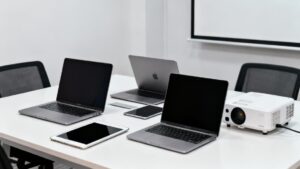
The most commonly rented technology categories through office tech rental services include:
• Laptops and ultrabooks — Business-grade and gaming-spec machines for development, design, and general productivity teams
• Desktops and all-in-ones — For finance, operations, and office-based roles requiring high-performance setups
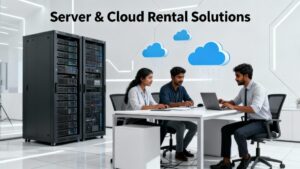
• Servers and NAS devices — IT infrastructure on rent for data-intensive workloads without the data center investment
• Networking and security hardware — Routers, switches, firewalls, and access points for office or event setups
• Display screens and projectors — For conference rooms, training facilities, and corporate events
• Printers and multifunction devices — Office-grade solutions without the upfront hardware cost
For companies building a complete office environment or equipping a remote workforce, business IT equipment rental through Indianrenters means a single vendor relationship covering every device category—simplifying procurement, vendor management, and ongoing support.
Why Are Indian Companies Shifting to Tech Rentals?
Indian companies are shifting to tech rentals because the business environment in 2026 rewards agility over asset accumulation—and because the economic, operational, and strategic case for renting has become impossible to ignore.
India’s startup ecosystem is among the most dynamic in the world, with thousands of companies scaling from 10 to 500 employees within two to three years. Traditional procurement processes cannot keep pace with that growth. Technology rental solutions provide the operational elasticity these businesses require.
Meanwhile, India’s large enterprise sector is dealing with a different pressure: global sustainability mandates and ESG reporting requirements that make responsible hardware disposal a boardroom issue. Renting reduces electronic waste by extending the lifecycle of devices through the rental provider’s asset management—and it eliminates the enterprise’s direct responsibility for end-of-life hardware.
Across both segments, the shift is also being driven by the quality and reach of rental providers. Companies like Indianrenters now offer pan-India delivery, rapid replacement guarantees, and enterprise-grade service agreements that match or exceed what a company’s internal IT team could provide for owned equipment.
Why Is Indianrenters a Leading Tech Rentals Company in India?
Indianrenters is a leading Tech Rentals Company in India because it combines the widest range of latest-generation IT equipment, pan-India logistics, proactive maintenance, and flexible rental plans—all under an enterprise-grade service model designed for the way Indian businesses actually operate in 2026.
Here is what sets Indianrenters apart:
• Extensive Equipment Range: From Laptop Rental and desktop solutions to servers, networking gear, and complete office tech setups—Indianrenters covers every category of IT and office equipment a business needs.
• Flexible Rental Plans: Short-term rentals for projects and events, and long-term contracts for ongoing operations—all structured to fit operational budgets without locking businesses into rigid agreements.
• Fast Pan-India Delivery: Whether a company is onboarding a team in Mumbai, Hyderabad, Chennai, or Tier 2 cities, Indianrenters delivers configured, ready-to-use equipment on timelines that match business needs.
• Proactive Maintenance and Rapid Replacement: Indianrenters manages maintenance proactively and replaces faulty equipment quickly—eliminating downtime that would otherwise cost businesses far more than the cost of any rental agreement.
• Predictable, Affordable Pricing: Fixed monthly rental rates mean no surprise costs, no depreciation write-offs, and straightforward budget forecasting across any team size.
• Startup and Enterprise Solutions: Indianrenters has built rental models that work for a 10-person startup renting five laptops as much as for a 2,000-person enterprise managing a distributed fleet across twelve cities.
• Dedicated Account and Technical Support: Every client gets dedicated support that understands their infrastructure needs—not a call center with scripted responses.
The result is a technology rental partner that reduces procurement complexity, improves IT reliability, and gives businesses the hardware foundation they need to compete without the financial burden of ownership.
The Future Belongs to Businesses That Stay Agile
The trends shaping 2026 and beyond all point in the same direction: businesses that stay asset-light, technology-current, and operationally flexible will outperform those weighed down by owned hardware.
AI-Driven Workplaces Demand Regular Upgrades
AI co-processors, neural processing units, and on-device machine learning capabilities are now standard in new business hardware. Companies that own three-year-old devices are running AI productivity tools at a fraction of their intended performance. Renting allows businesses to upgrade to AI-native hardware as it becomes available, keeping teams at peak productivity without a replacement capital cycle.
Hybrid Work Requires Scalable, Distributed Infrastructure
Hybrid work is not a trend that peaked and faded—it is the permanent operating model for knowledge workers in 2026. Managing owned hardware across dozens of home locations and multiple office sites creates enormous IT complexity. Scalable IT rental solutions allow companies to provision, configure, and replace devices across distributed locations with a single vendor relationship, dramatically simplifying infrastructure management.
Sustainability and Reduced E-Waste
Electronic waste is India’s fastest-growing waste category, and regulatory pressure on businesses to demonstrate responsible disposal practices is intensifying. When a business rents technology, the rental provider manages the full lifecycle of the device—including refurbishment, reuse, and responsible recycling. Companies that rent significantly reduce their direct contribution to e-waste while satisfying ESG reporting requirements without additional operational overhead.
Ownership, in this context, is not just financially inefficient—it is increasingly at odds with where business, regulation, and corporate responsibility are heading.
Frequently Asked Questions
Not when the full cost of ownership is considered. Renting eliminates upfront capital costs, maintenance expenses, repair bills, hardware replacement cycles, and disposal costs—making the true cost comparison strongly favourable to rental, especially for equipment held fewer than five years.
Yes. Laptop Rental services are specifically designed to be accessible for small teams. Indianrenters offers rental plans starting from a single device, with monthly pricing that is well within budget for early-stage companies. Startups can scale their device count up or down as their team size changes.
With Indianrenters, maintenance and replacement are included in the rental agreement. If a device fails, it is repaired or replaced—typically within one business day in major cities. This means no downtime liability and no unexpected repair bills for the business.
Yes. Rental payments for business equipment are classified as operating expenses (OPEX) under Indian accounting standards and are fully deductible in the financial year they are incurred—unlike purchased equipment, which must be depreciated over time as a capital asset.
Indianrenters operates a pan-India logistics network that enables rapid deployment across major metros and Tier 2 cities. For standard configurations, equipment is typically delivered and operational within two to three business days of the rental agreement being confirmed.
Conclusion: The Case for Renting Is Closed
The argument for buying tech equipment outright in 2026 is increasingly difficult to make. Depreciation is faster. Technology cycles are shorter. Hybrid work demands flexibility that ownership cannot provide. Environmental and regulatory pressures on e-waste management are growing. And the financial case for converting capital expenditures into predictable operating expenses is compelling for any business that values growth over asset accumulation.
Renting tech equipment in 2026 is not a short-term fix—it is a long-term strategic decision that gives businesses the agility to grow, the flexibility to adapt, and the financial clarity to invest where it matters most.
Indianrenters exists to make that decision easy. As a trusted Tech Rentals Company in India with deep expertise in IT and office equipment rentals, Indianrenters has helped hundreds of startups, SMEs, and enterprises equip their teams with the right technology—on time, on budget, and without the weight of ownership.