
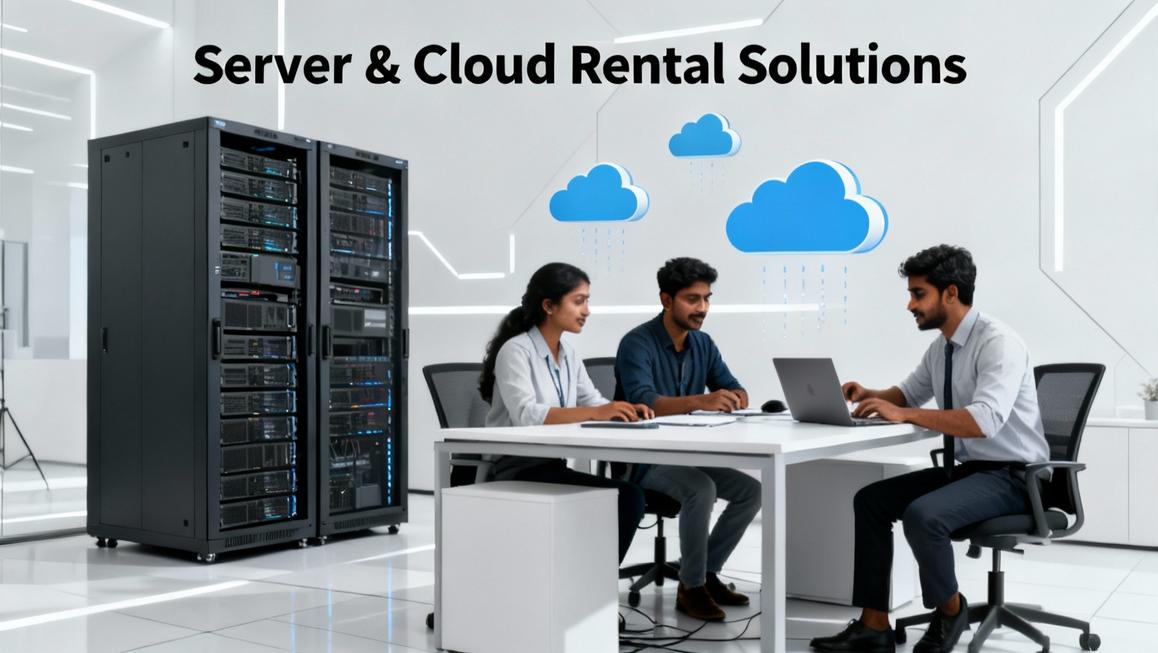
Explore 2026 insights on server rental versus cloud services rental in India with real data on infrastructure growth, hybrid adoption, ROI and strategic fit.
In our 33+ years serving Indian businesses, we’ve observed how the choice between server rental and cloud services rental can reshape IT strategy in days. With India’s cloud services market poised to reach $13 billion by 2026 and data centre capacity doubling to 2 GW, the stakes are high and the decisions urgent.
Many IT managers face friction in balancing control, scalability and agility without stretching CAPEX. Should you opt for rented servers under your oversight or trust flexible cloud services rental? This decision defines your infrastructure resilience and long term return.
We’ll help you assess both options with real specifications, market trends and business value insights, so your team—from Delhi to Bengaluru—can align infrastructure choices with strategic goals in 2026 and beyond.
Deep Dive
Infrastructure landscape and market context
India’s data centre capacity stands at around 950 MW and is set to rise to approximately 1 800 MW by 2026, positioning the country as a leading Asia Pacific data centre hub beyond China. This reflects demand for local server reliability, particularly for industries focused on compliance, latency or predictability. Infrastructure growth supports server rental models in cities like Mumbai, Hyderabad, Bengaluru and Noida where physical access matters. Our experience in Pune and Hyderabad confirms demand from enterprises aiming to avoid long term capital expenditure and preserve financial planning flexibility.
Meanwhile, the public cloud services market is forecast to hit $13 billion by 2026, growing at over 23 percent CAGR. SaaS, IaaS and PaaS segments are expanding rapidly under cloud services rental, especially for digital transformation and hybrid work models. IDC reports public cloud services revenue is already in multi‑billion dollar range and expected to more than double. These trends show strong momentum for cloud services adoption across MSMEs, GCCs and digital native businesses.
Adoption trends and hybrid strategies
A report shows today about 12 percent of Indian organisations use hybrid multicloud infrastructure combining private and public environments. That figure is expected to rise five‑fold to nearly 63 percent by 2026. That means most businesses do not choose one path; they align to applications and workloads with partial server rental for mission critical control and cloud services rental for bursting workloads like AI, data analytics or apps with seasonal demand.
This adoption model offers flexibility, keeps data on rented hardware when predictable, and scales dynamically via cloud rental when demand spikes, such as during financial year closeouts or event seasons in Mumbai and Delhi. It also supports India‑specific concerns around data sovereignty and visibility.
Economic impact and strategic ROI
Industry analysis shows large scale cloud adoption can contribute around 8 percent of India’s GDP and generate roughly 14 million jobs by 2026. The cloud economy may add $310‑380 billion to the economy. These numbers highlight how cloud services rental can power digital inclusion, entrepreneurship and business expansion.
For government use, community and hybrid clouds are estimated to save agencies up to 30‑40 percent of infrastructure effort while enabling e‑service deployment in weeks instead of months. This underscores how rental cloud services can deliver operational ROI without purchase delay.
Technical suitability and performance benchmarks
Server rental brings predictability, dedicated resources and control over OS and networking. For workloads requiring consistent IOPS or custom hardware such as GPUs for AI or rendering, renters can get specific configurations rapidly without CAPEX. Support, maintenance, upgrades and deployment across Delhi, Mumbai or Pune are handled by rental teams maintaining uptime reliability.
Cloud services rental delivers elasticity, auto scaling, container or serverless options, and easy integration with AI tools. Modern infrastructure includes container orchestration, edge APIs, Kubernetes adoption and AI platform access. Cloud rental is especially strong for micro services or applications for remote users.
Real world business use cases in India
- A Bengaluru fintech startup rents servers for secure payment processing behind corporate firewalls and taps cloud services rental for customer analytics during campaign peaks.
- An event management firm in Hyderabad chooses rented servers for on‑site AV streaming and backup, while using cloud rental for ticketing applications with uneven loads.
- A corporate training provider in Noida relies on rented servers during scheduled offline sessions and scales via cloud services rental for online course delivery during enrollment seasons.
Value proposition with rental models
Server rental and cloud services rental both offer flexible financial planning and cost effective without capital expenditure benefits. You preserve capital for core operations, shift IT under OPEX, and avoid procurement delays. Cloud services rental adds agility, while server rental sustains control and performance consistency. Our clients in Delhi, Mumbai and Bengaluru report easier budget approvals and faster deployment when IT is treated as rental.
Brand awareness on reliability, updated models and support is vital. IndianRenters’ pan India network ensures delivery and support across hubs, offering hardware that meets current 2026 specifications. Our 33+ years experience ensures you get compliant, optimised infrastructure matched to hybrid IT strategies.
Key Takeaways
- India’s data centre capacity is doubling to about 1 800 MW by 2026, supporting strong server rental infrastructure across key cities.
- Public cloud services market is set to reach $13 billion by 2026, with over 23 percent CAGR, making cloud services rental a mainstream strategy.
- Hybrid multicloud usage in India is growing from 12 percent to potentially 63 percent by 2026, showing balanced adoption of server rental and cloud services rental.
- Cloud adoption may add 8 percent to GDP and create 14 million jobs by 2026, illustrating broader strategic impact beyond infrastructure choice.
- Server rental provides dedicated control and performance, cloud rental gives elasticity and innovation access; IndianRenters offers both across Delhi, Mumbai, Bengaluru, Pune, Hyderabad, Noida.
Wrap-up
The initial decision between server rental and cloud services rental reflects deeper trade offs: control versus scale, CAPEX versus OPEX, predictability versus flexibility. With India’s infrastructure expanding and hybrid adoption surging, informed leaders can match workloads to the right model.
Having explored market data and real world cases, you now understand how each path delivers value when aligned with technical, financial and business priorities. IndianRenters brings you both options across major cities backed by decades of rental experience and support.