
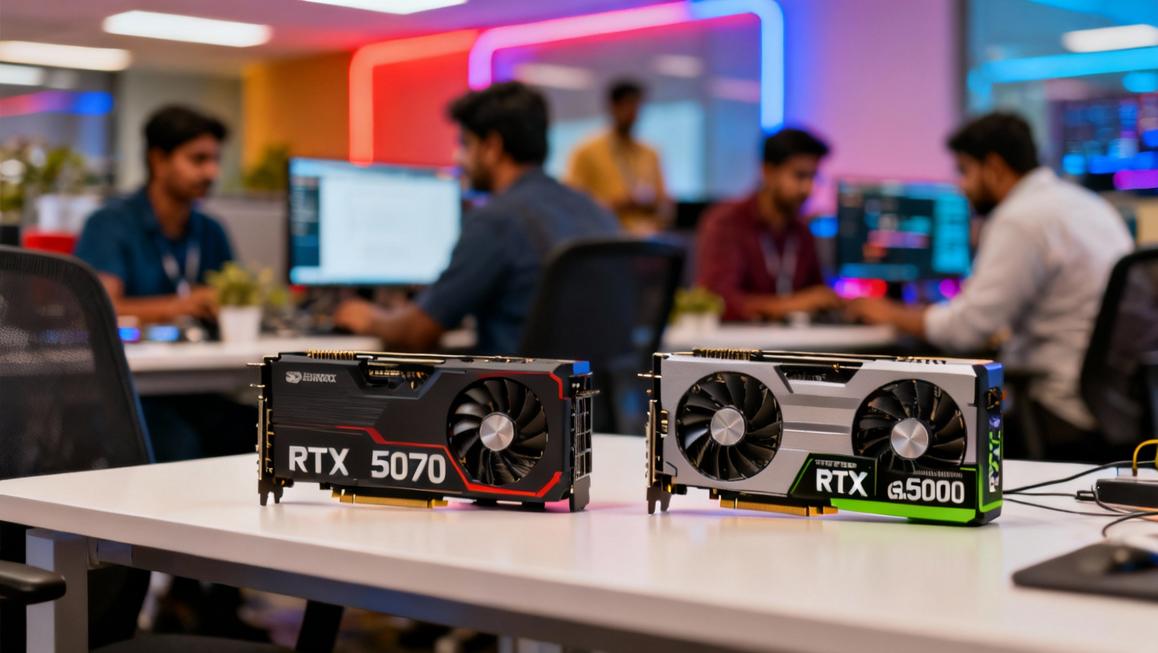
Compare the RTX 5090 rental versus RTX 5000 Ada Lovelace hire in 2025, featuring fresh specs, performance benchmarks, use cases and value insights.
In our 33+ years serving IT projects across Delhi, Mumbai, Bengaluru and beyond, we’ve seen computing needs shift rapidly with AI workflows and content creation contending for graphics horsepower. A standout insight in 2025: the GeForce RTX 5090 delivers up to 3x higher benchmark scores over the RTX 5000 Ada Lovelace in 3DMark Time Spy tests, a gap that signals distinct use case fit.
Businesses constrained by project cycles or seasonal spikes wrestle between gaming‑grade power and professional accuracy when choosing graphics rental gear. Performance differences often translate into missed deadlines or over‑provisioned systems that hurt ROI. After reading, you’ll understand how live performance stats help you match GPU rentals or hires to workflows, preserve capital with a flexible approach, and deliver predictable returns without capital expenditure.
Deep Dive
Starting at the surface, the RTX 5090 and RTX 5000 Ada Lovelace both sport 32GB of memory—but that’s where similarities end. The RTX 5090 uses GDDR7 on a 512‑bit bus, achieving an enormous 1,792 GB/s bandwidth, while the RTX 5000 Ada pairs GDDR6 with a 256‑bit interface at 576 GB/s. That’s over three times the memory throughput in the RTX 5090, making a big difference when rendering 8K frames or loading large texture sets in real time. In our Mumbai and Pune client setups, we’ve seen bandwidth constraints slow down video renders on professional GPUs.
Specifications speak to different design priorities. The RTX 5090 packs 21,760 CUDA cores, 170 RT cores, and 680 Tensor cores—yielding around 104.8 TFLOPS of FP32 compute. Meanwhile, the RTX 5000 Adatops at about 12,800 CUDA cores, 100 RT, and 400 Tensor, delivering roughly 65.3 TFLOPS. The jump in shader counts and memory bandwidth explains why benchmark tests measure RTX 5090 scoring 3DMark Time Spy 47,510 vs 14,170—roughly 235 % higher throughput for the GeForce model.
- RTX 5090 memory bandwidth: 1.79 TB/s vs 576 GB/s
- RTX 5090 FP32: ~104 TFLOPS vs RTX 5000’s ~65 TFLOPS
- 3DMark Time Spy: RTX 5090 ~47,500 vs RTX 5000 ~14,170
That raw performance advantage delivers clear value for gaming, video editing, 3D modelling, and hybrid production. A benchmark suite shows Blender rendering 14,945 pts on RTX 5090 versus 6,013 on RTX 5000—a 150 % boost in real application performance.
Use Cases for RTX 5090 Rental
The RTX 5090 excelled in tasks with pixel‑pushing demand. In tests, Cyberpunk 2077 ran at 238 fps with DLSS 4 on the RTX 5090 compared to 106 fps on RTX 4090. That real-world gain translates to smoother real‑time previews and rendering during project crunches. For Delhi‑based production houses, putting RTX 5090 rentals on short‑term hire lets teams deliver high‑fps editing benchmarks without long‑term commitment.
Because of its higher power draw—about 575 W TDP vs the RTX 5000’s 250 W—the RTX 5090 requires robust cooling and a PSU capable of 1000 W or more. Our experience shows event managers in Bengaluru planning GPUs for hybrid events budget time for power certifications and thermal support.
Why Hire RTX 5000 Ada Lovelace?
The RTX 5000 Ada is built for professional workloads where ECC memory, virtualization and stability count. With memory error‑correcting code, dual AV1 encode/decode engines, and support for NVIDIA’s AI Enterprise stack, it fits well in virtual workstation farms used by corporates in Hyderabad and Noida. Its 250 W power envelope also reduces infrastructure needs.
Benchmarks show the RTX 5000 Ada’s boost clock is higher (around 2,550 MHz vs RTX 5090’s ~2,407 MHz) and it drives accurate render results with third‑gen RT cores and fourth‑gen Tensor Cores. That consistency matters when training generative AI or doing VFX work that demands repeatable inference across datasets.
Comparison Summary
- Memory Type: RTX 5090 uses GDDR7 vs RTX 5000’s GDDR6
- Compute Power: RTX 5090 ~60 % higher FP32 performance
- Power Draw: RTX 5090 ~575 W vs RTX 5000 Ada ~250 W
- Clock Speeds: RTX 5000 Ada has ~6 % higher boost clock
- Virtualization: RTX 5000 supports vWS and ECC features
- Performance vs Price: RTX 5090 sells US commentators say it outperforms RTX 4090 by 2× in some workflows
In practical deployment, our clients doing 3D animation or esports events love how RTX 5090 rental accelerates turnaround. Meanwhile enterprises running LLM model training or high‑end VFX pipelines tend to prefer RTX 5000 Ada hire for stability, ECC memory and infrastructure ease.
Scenarios Matching GPU to Needs
- Video editing burst for an ad campaign? RTX 5090 rental gives fastest export times; you avoid long term overhead.
- Virtual workstation pool for architects in Pune? RTX 5000 Ada hire covers ECC, virtualization and reliability.
- Hybrid cloud‑on‑prem AI tasks across fiscal year planning? Mixing short‑term RTX 5090 bursts with longer RTX 5000 compute blocks optimizes OPEX vs CAPEX.
That mix aligns with financial year cycles in Indian MSMEs and gives optimized investment strategy: preserve capital for core ops while scaling GPU compute as needed without overcommitment.
Key Takeaways
- The RTX 5090 delivers roughly 60 % more FP32 throughput and over 200 % higher benchmark scores than RTX 5000 Ada—ideal for gaming and creative workloads.
- Memory bandwidth in RTX 5090 is over 3× that of RTX 5000 Ada, boosting 8K and large texture performance.
- RTX 5000 Ada offers ECC memory, virtualization support and lower power draw—benefiting AI inference and enterprise reliability.
- Renting RTX 5090 suits burst workloads like video production or 3D rendering with a budget friendly approach without capital expenditure.
- Hiring RTX 5000 Ada supports consistent professional compute needs, with flexible financial planning and brand awareness of stability.
Wrap‑up
You began with a choice between raw creative speed and professional reliability. You now understand that the RTX 5090 rental offers unmatched performance boosts where time matters, while the RTX 5000 Ada hire brings precision, ECC memory and virtualization for enterprise tasks. That clarity helps you preserve capital, align with hybrid workflows, and deliver dependable results across Delhi, Mumbai, Bengaluru, Pune, Hyderabad and Noida.